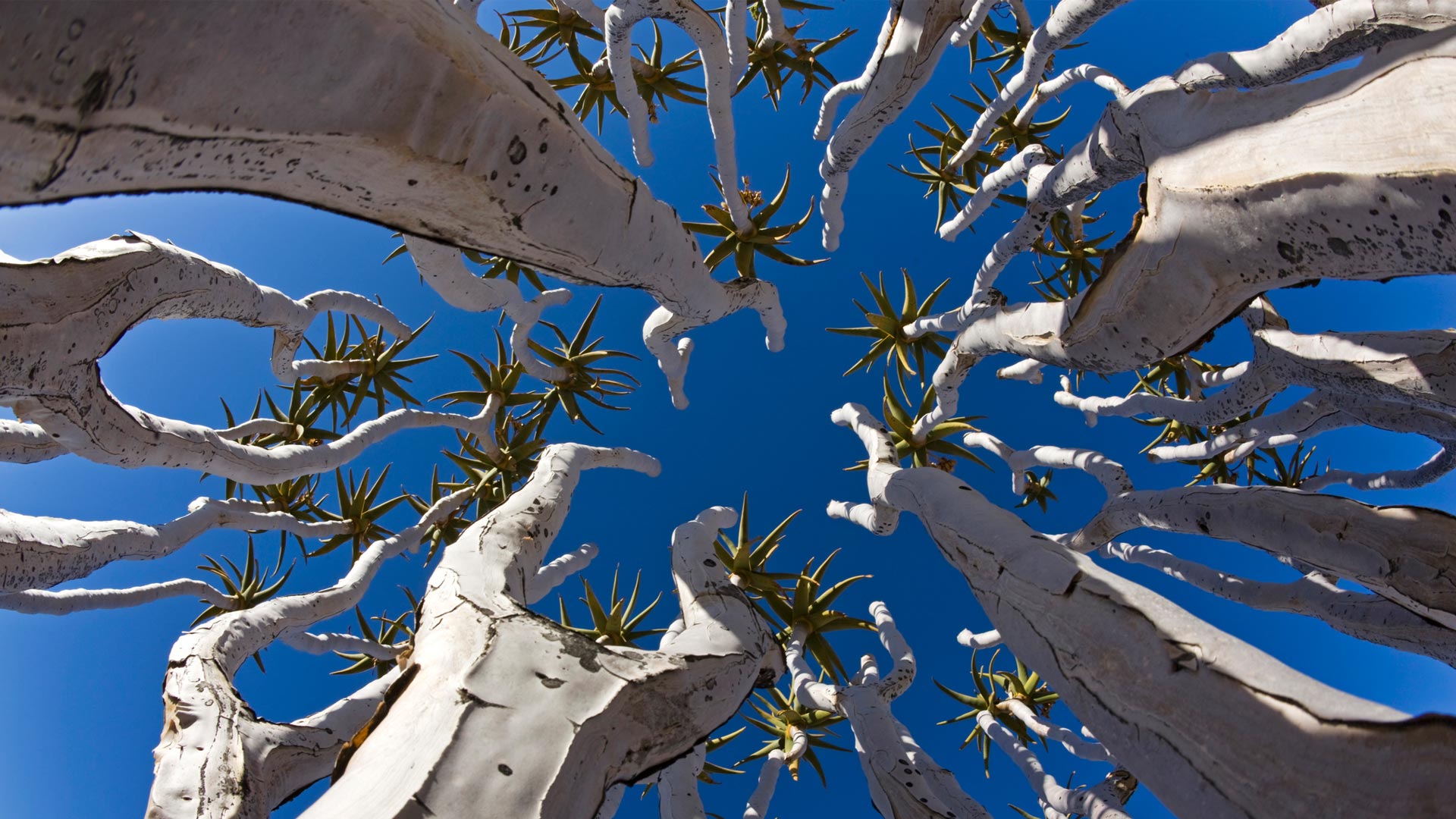
The quiver trees pictured on our homepage are uniquely suited to Namibia"s hot, dry climate. They are not trees at all, but an endangered species of aloe plant. These succulents can grow up to 30 feet tall and live for 200 years. The name comes from the Indigenous San people who made quivers out of the plant"s tube-shaped branches to hold their arrows while hunting. You can see scattered quiver trees across southern Namibia, but for sheer numbers, head to the Quiver Tree Forest, where more than 200 of these distinctive plants grow among dolerite rock formations outside the city of Keetmanshoop. In June and July, during Namibia"s winter, you can see the plant"s flowers in bright, yellow bloom.
Quiver trees in Namibia
Today in History
More Desktop Wallpapers:
-
Where is this wintry road?
-
World Nature Conservation Day
-
Uredd Rest Area, Norway
-
Super sandy Sweet 16
-
Joshua Tree National Park
-
Take the Stairs Day
-
Finding a balance between wetlands and water treatment
-
A peek behind the royal curtain
-
Have fun storming the castle
-
Paro Tsechu Festival in Bhutan
-
Assembling the Smithsonian
-
It s fair season
-
World Space Week begins
-
Happy Valentines Day!
-
Brown bears, Katmai National Park and Preserve, Alaska
-
Alaska National Interest Lands Conservation Act anniversary
-
Of balloons and lost pantaloons
-
Happy New Year!
-
Svolvaer, Lofoten Islands, Norway
-
Gulf Islands National Seashore, Florida
-
The Blue City of Jodhpur, Rajasthan, India
-
Go Fly a Kite Day
-
A festival of lights in India
-
The Hermitage of Santa Justa
-
A house of grand scale(s)
-
Camels in the desert, United Arab Emirates
-
Great cormorants
-
Sanday Island and the North Sea, Scotland
-
Wayag Islands in the Raja Ampat Islands of Indonesia
-
A grand event
Bing Wallpaper Gallery