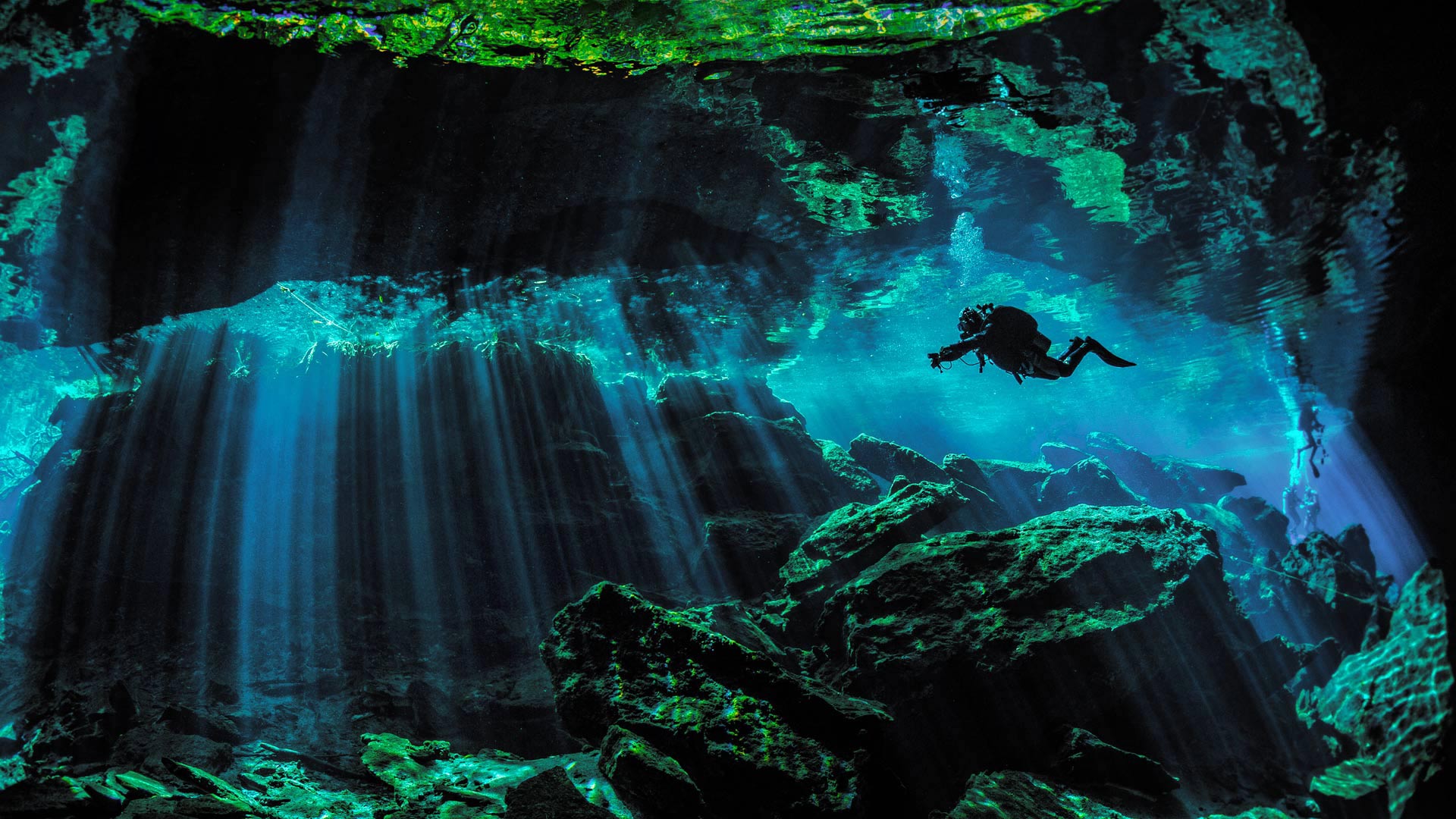
Like a giant block of Swiss cheese, Mexico"s Yucatán Peninsula is riddled with holes called cenotes. Cenotes form when subterranean limestone dissolves, allowing underground water to penetrate. The rock above may cave in, forming a sinkhole that reveals the cool, often crystal-clear water. Other cenotes may remain below the surface, hidden and often unexplored. Cenotes vary in size from very small to several dozen yards across, and recent discoveries have shown that some cenotes lead to a series of underground cave systems that can span several miles in length.

Cenote near Puerto Aventuras, Mexico
Today in History
More Desktop Wallpapers:
-
Plate ice along Lake Superior, Grand Marais, Minnesota
-
Canadian Thanksgiving
-
Manatees rebound
-
Struck by Southwestern beauty
-
Illuminated Uluru
-
Busy building wetlands
-
Mam Tor, Derbyshire, England
-
Pearl Harbor Day
-
It s Mountain Day in Japan
-
Seitan Limania Beach, Crete
-
A bridge too Fawr
-
On a Healing Field for Veterans Day
-
Detroit Industry Murals by Diego Rivera
-
World Migratory Bird Day
-
A spectacle unlike any other
-
Beech trees and wild anemones, Jutland, Denmark
-
Asteroid Day
-
Go Fly a Kite Day
-
Upper Geyser Basin, Yellowstone National Park
-
Celebrating Yi Peng
-
An emerald isle of the Emerald Isle
-
Cuban tody, Alejandro de Humboldt National Park, Cuba
-
It s Census Day—make it count
-
World Migratory Bird Day
-
Cheetah in Ngorongoro Conservation Area, Tanzania
-
Why’s it called a spelling ‘bee,’ anyhow?
-
Martinique
-
Capitol Reef National Park, Utah
-
Happy Thanksgiving!
-
Looking down on the Otter
Bing Wallpaper Gallery