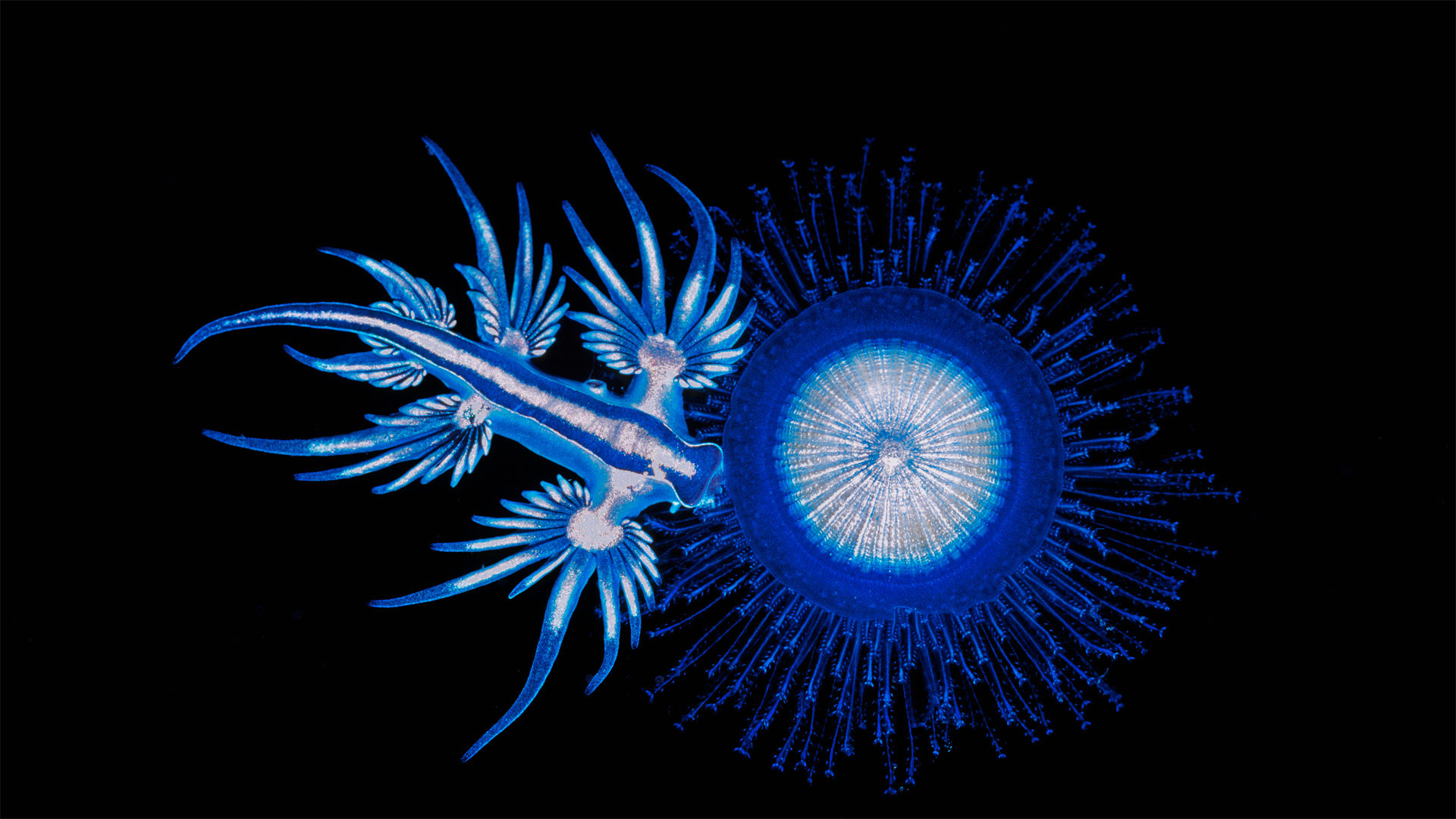
No, this isn"t a still image from a sci-fi space opera. We"re offshore of Coffs Harbour, New South Wales, Australia, watching a Glaucus atlanticus, aka "sea swallow" or "blue sea dragon," snack on the poisonous tentacles of a Porpita porpita, aka "blue button." At the tips of the blue button"s tentacles are stinging cells called nematocysts, but the venom doesn"t deter the sea swallow. Instead, once the sea swallow ingests the blue button"s poison, it stores the venom in the tips of its own feather-like fingers called papillae. Would-be predators should think twice before biting the sea swallow. The poison concentrated in its papillae can kill a predator in seconds. If you come across either of these creatures washed ashore, don"t touch! While the stings aren"t deadly to humans, they can cause skin irritation.
What are these creatures?
Today in History
More Desktop Wallpapers:
-
Exploring the Pearl of the Atlantic
-
Ambassadors of the airwaves
-
Take a hike near Lovers Lane
-
Provence blooms with lavender at Sénanque Abbey
-
Vietnam’s new bridge deserves a big hand
-
Is there a bug-egg emoji for this?
-
A species worth defending
-
Inhale and exhale, it’s Yoga Day
-
It s tree-climbing season
-
Hoodoos, Sunset Point, Bryce Canyon National Park, Utah
-
Gulf Islands National Seashore, Florida
-
The National Museum of the American Indian
-
Hiding in plain sight
-
National Frog Month
-
World Population Day
-
Manatee Awareness Month
-
Gespensterwald, Nienhagen, Germany
-
Wychwood Forest, Oxfordshire, England
-
The snows of Fuji
-
Happy Easter from the ‘peeps’ at Bing
-
Megalong Valley, Blue Mountains National Park, Australia
-
Let’s have a ball
-
Boating on the Bojo
-
Bonsai Rock, Lake Tahoe, Nevada
-
Grasmere, Lake District, Cumbria, England
-
Polar Bear Week
-
In the Garden of Europe
-
Tracking ships on the Day of the Seafarer
-
Cuban tody, Alejandro de Humboldt National Park, Cuba
-
In memory of those lost
Bing Wallpaper Gallery